

The cheapest plan isn’t always the fairest one. To learn how to budget for a group trip, start by estimating the full cost, dividing shared expenses in a way everyone agrees on, and separating personal spending from group costs. Include the journey to the destination, not just the stay, and leave room in the plan for unexpected expenses.
Money can feel awkward among friends, especially when people have different priorities or one person pays upfront. Agreeing on costs before anyone books can make these conversations easier and prevent one traveller from carrying more than their share.
This guide explains how to set a realistic per-person budget in Malaysian ringgit, split costs fairly, find savings, and account for different comfort levels. You’ll also learn how to agree on payment deadlines and handle a missed contribution, so everyone can make decisions with care and start planning on solid ground.
Key Takeaways
- List shared essentials separately from personal extras so everyone knows what the group budget covers.
- Estimate transport, meals, activities and local expenses alongside accommodation before agreeing on a per-person amount.
- Set a budget that reflects the group’s different financial priorities, then agree on payment deadlines before anyone books.
- Look for savings by comparing travel dates and choosing trip details that fit the group’s spending limits.
- Match the accommodation to your group size and budget, from a Budget Chalet for 2 Pax to a Grand Villa for 6 Pax.
How do you split trip costs fairly between friends?
Start with a shared cost list, then separate group expenses from personal choices. For a fair per-person split, account for travel, accommodation, and what each person will actually use.
-
List Essential and Optional Trip Costs
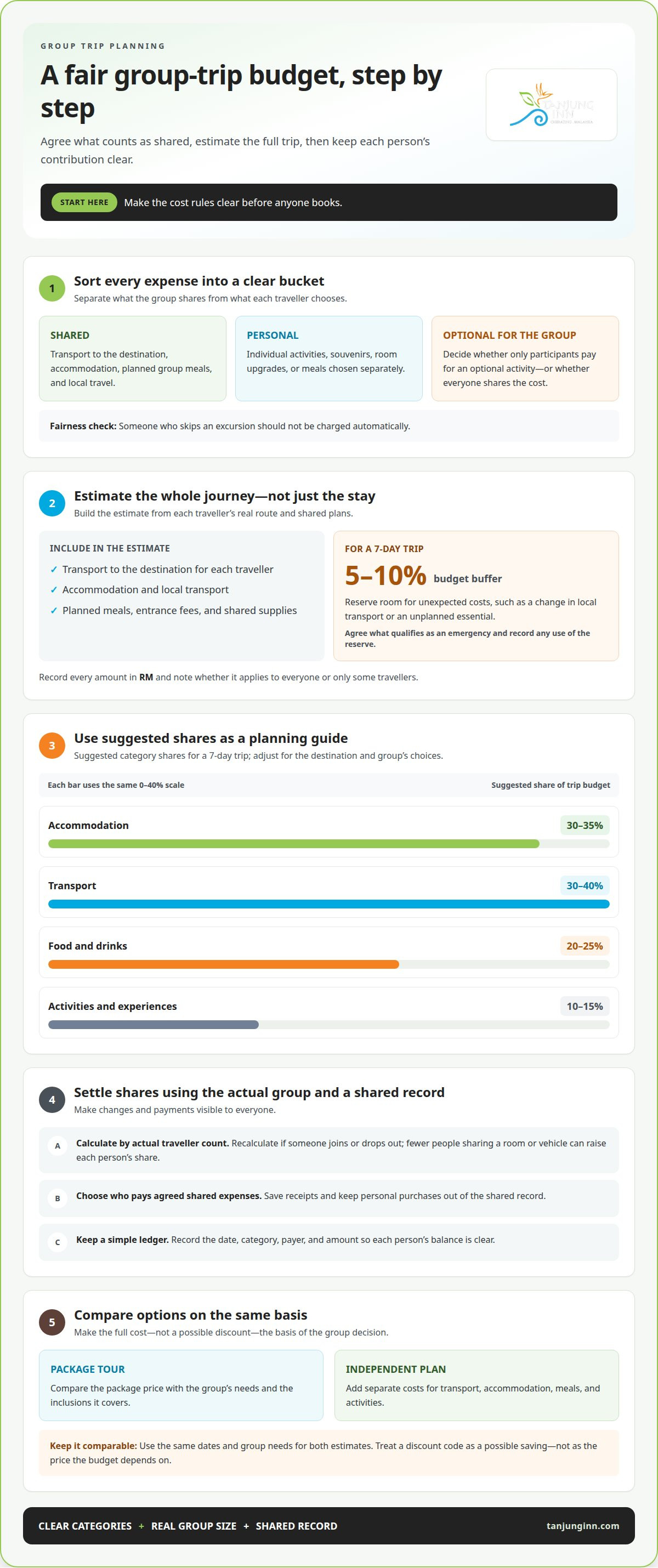
List the costs everyone needs to consider before anyone books. Essentials may include transport to the destination, accommodation, meals the group plans together, and local travel. Optional costs may include individual activities, souvenirs, room upgrades, or meals someone chooses separately.
Label each item as shared, personal, or optional for the group. Then agree whether optional activities are paid for only by participants or divided among everyone. This prevents someone who skips an excursion from being charged automatically. To compare package tours with an independently planned trip, weigh the full package price against separate costs for transport, accommodation, meals, and activities. Use the same dates and group needs for both estimates.
-
Estimate Travel and Operating Costs
Estimate the cost of reaching the destination for each traveller, not just the expenses after arrival. In Malaysia, people travelling from different states may have different transport options and journey costs. Add local transport, planned meals, entrance fees, and shared supplies. List each expense in RM and mark whether it applies to everyone or only some travellers.
For a seven-day group trip, leave a 5-10% budget buffer for unexpected costs. This reserve can absorb a change in local transport or an unplanned essential, without quietly increasing everyone’s contribution later. Decide together what qualifies as an emergency, and record any use of the reserve in the expense log.
-
Allocate Shared Costs by Category
Group the list into accommodation, transport, food and drinks, and activities. For a seven-day trip, suggested budget shares are 30-35% for accommodation, 30-40% for transport, 20-25% for food and drinks, and 10-15% for activities and experiences. Treat these as planning guides, then adjust them to the destination and group’s choices.
Choose one person to pay agreed shared expenses and save receipts in a shared record. Settle each person’s portion according to the agreed split rather than relying on memory at the end. Keep personal purchases out of this record. A simple ledger showing the date, category, payer, and amount makes the balance clear to everyone.
-
Account for Group Size and Booking Timing
Calculate each person’s share using the actual number of travellers, since accommodation, inclusions, destination, and trip length all affect the total. Recalculate if someone joins or drops out before booking. A room or vehicle shared by fewer people can increase each person’s share, so agree on how to handle changes before paying.
Compare booking options early, while the group can still adjust dates or plans together. A discount code may help with early booking, but build the budget around the price the group can see, not a possible promotion. Package tours can simplify comparisons when their inclusions match the group’s needs; independent planning may suit a group that wants to choose each expense separately.
Researching destination expenses and finding deals
Research likely local spending before setting a daily limit. For a trip in Malaysia, compare expected transport, meal, and activity costs for the destination and dates.
- Build a destination cost estimate from specific plans, not a general travel figure. Check likely routes, meal choices, entry fees, and local transport needs, then record each amount in RM. A beach day with a paid activity will cost differently from a day spent walking or resting. Use the same dates and itinerary assumptions for each option you compare.
Look for savings that fit the group’s plans, such as a discount code or a lower-cost activity on a free day. A deal helps only if it replaces an expense the group would otherwise choose. Keep the original estimate beside the revised amount so everyone can see what changed and why.
- For a hosted group trip, include the host’s travel costs and time away from work in the plan. The host’s journey may cost more than other guests’ travel, especially if they are carrying supplies or arriving early. Decide openly whether those expenses are shared, covered by the host, or included in the overall contribution.
Separate reimbursement from profit. The host can list necessary travel and operating costs, then decide whether the group price needs an additional margin. Don’t hide personal expenses in a shared category. A clear breakdown shows the host’s effort without leaving other travellers unsure about what they are paying for.
- Set a daily shared-expense cap in RM after reviewing the group’s planned meals and local travel. The right limit depends on the destination, itinerary, and spending priorities. Define what counts toward the cap, such as a shared meal or local transport, and what remains personal, such as souvenirs or an individual café stop.
Agree on what to do if a day exceeds the limit. The group might choose a lower-cost meal later or approve an extra shared expense together. Keep personal purchases out of the shared tally, even if several people make them at once.
- Track costs during the trip instead of reconstructing them afterward. Keep receipts or a shared digital record with the date, amount in RM, payer, and category. During a 7-day trip, a two-minute expense review every other day can help the group notice a rising total while there is still time to adjust.
At each review, compare spending with the agreed cap and record any exception. After returning home, settle group-trip balances within 24-48 hours. A brief, itemised summary helps each traveller understand the final amount and gives the payer a clear record of shared expenses.
Agreeing on a per-person budget before booking
Before anyone pays, agree on a maximum per-person total in RM that includes travel to and from the destination. Before committing, read the written booking conditions for deposit amounts, due dates, cancellation charges, and refund timing.
- Ask each traveller privately for a comfortable spending range, then discuss the overlap as a group. A short poll can show whether people prefer a quiet getaway or a trip with more activities, without asking anyone to disclose their income. For a trip in Malaysia, estimate transport, accommodation, food, and experiences in RM. Include the journey to the destination, since travellers starting in different states may have different travel costs.
Use the group’s shared comfort range to shape the trip, not the most expensive preference. If the itinerary exceeds what people can manage, adjust the dates, length, or activities before booking. Don’t treat silence as agreement. Ask everyone to confirm the same per-person limit.
- Turn the agreed limit into a working budget with clear categories. Separate fixed commitments, such as accommodation, from flexible spending, such as meals or optional activities. Show each traveller their estimated share and what it covers. For example, state whether it includes return transport and group experiences instead of presenting one unexplained total.
A practical way to approach how to budget for a group trip is to separate shared essentials from individual choices. If one traveller wants a private room or an extra outing, agree whether they will pay the additional cost. This keeps the common budget fair for people with different priorities and prevents personal preferences from quietly increasing everyone’s share.
- Set payment milestones that match the booking conditions and the group’s cash flow. Record who pays each amount, when it is due, and how the group will handle a late contribution. If a booking requires a deposit, make sure everyone knows the amount and deadline before one person pays on the group’s behalf.
Write down the cancellation process too. Note whether a cancellation changes the remaining travellers’ shares, what happens to money already paid, and how any refund will be divided. Agree on these details before booking, not while trying to manage a change of plans.
- Test the budget against a realistic saving plan before choosing dates. Divide each person’s estimated contribution by the months available, then consider it alongside regular bills, savings goals, and other commitments. If someone can’t manage the schedule, adjust the plan together rather than pressuring them to borrow or overextend.
Deciding how to budget for a group trip also means agreeing on the final plan before anyone makes a non-refundable commitment. Share the total, category breakdown, and payment schedule in one record. Each traveller can confirm the same arrangement, giving the group a clear basis for booking.
Balancing travel goals with other financial priorities
Give each traveller room to weigh the trip against bills, savings, family needs, and time away from work. A shared plan should respect different limits, not assume everyone can spend the same amount.
- Ask each person to name a comfortable contribution and a preferred travel goal. One traveller may value a quiet stay, while another wants to spend more on activities. Invite people to share privately if that feels easier, then use their responses to find a workable range without asking anyone to explain their personal finances.
Sort the group’s priorities into essential, preferred, and optional choices. For example, the group might keep the planned travel dates but shorten the itinerary to reduce spending. Keep a choice only if it fits the comfort range agreed by the people taking part.
- Help each traveller test the proposed contribution against their monthly commitments. Divide their estimated share by the months remaining before payment is due. Compare that amount with regular expenses and savings goals, then adjust the trip plan if the saving pace feels difficult.
A longer planning window can make it easier to spread contributions across pay periods. If someone needs more time, consider a later trip date or a simpler itinerary. Don’t treat borrowing or postponing essential bills as a reasonable way to make the group budget work.
- Make trade-offs clear before the group commits. If a preferred activity raises the shared total, ask whether participants want to pay for it individually or replace another plan. A traveller who values rest may prefer unstructured time, while someone seeking variety can choose an optional outing at their own expense.
Agree on a lower-cost alternative for each major shared choice. For example, compare a full day of paid activities with a slower day built around free time and one selected experience. This gives the group a clear fallback if the original plan exceeds someone’s limit.
- Account for the host’s time away from work and travel expenses when setting financial expectations. List necessary hosting costs separately, then decide openly whether the group shares them or the host covers them. Don’t assume the host’s time has no value or add an unexplained amount to everyone’s contribution.
Before booking, ask every traveller to confirm the final plan and payment schedule. If someone’s priorities change, revisit the shared choices rather than applying pressure. The group can preserve its travel goal by changing dates, activities, or trip length, while leaving everyone room for financial commitments at home.
Budgeting for family or group travel
Plan around the people travelling, not an assumed equal budget. For a Malaysian family or mixed group, account for different household commitments, room needs, and ideas of a worthwhile break.
- Ask each household to identify its essential commitments before discussing travel extras. A family paying school expenses may prefer a shorter stay, while another group member may have more room for optional activities. Use private responses to understand the group’s comfortable spending range, then build shared plans around what participants can manage.
Keep the discussion focused on choices, not anyone’s income. For example, compare a relaxed itinerary with fewer paid activities against a busier one. Let each household say which version feels manageable before the group settles on dates or books.
- Work out accommodation needs by household and sleeping arrangements instead of dividing the total blindly. A family travelling with children may want to stay together, while friends may prefer separate rooms. List who will share each space and agree how to divide the cost when room sizes or privacy differ.
For example, if one household chooses a larger room for its own comfort, decide whether it will cover the difference. If everyone uses the same shared space, agree on a consistent split. A written arrangement prevents one family’s needs from becoming an unplanned cost for another.
- Give families flexibility around meals, activities, and personal routines. Parents may choose an early evening, while other travellers prefer a later outing. Set a shared plan for group meals or experiences, then leave optional choices to the people who take part. This avoids charging a household for activities it skips.
Include practical family needs in the itinerary, such as rest breaks, familiar meal options, and time without scheduled activities. These choices can affect transport and food spending as much as the destination itself. A simple daily plan helps each household see which expenses are shared and which are personal.
- Agree on a fallback before booking. If the preferred dates or accommodation exceed the group’s agreed limit, choose a simpler itinerary, shorten the stay, or revisit the travel dates. Keep the original priorities visible so savings come from lower-priority choices rather than quietly shifting extra costs onto one household.
For a family escape, explore accommodation options for family groups while shaping a plan around group size and comfort. Before anyone commits, share the final arrangement with every household and record how shared costs will be divided. Clear choices make room for different budgets and a calmer journey.
Tanjung Inn: Budget Chalet for 2 Pax
Tanjung Inn gives travellers a lodging option to include when shaping a group budget. For two people travelling together, the Budget Chalet for 2 Pax offers a clearly sized accommodation choice to consider alongside transport, meals, and activities. Matching the stay to the group’s actual numbers can help keep the plan grounded.
For larger groups, compare the Grand Villa for 6 Pax, Family Villa 5 for 5 Pax, and Family Villa 4 for 4 Pax with your intended room arrangements. These options give families and friends different group sizes to consider while deciding how to share accommodation costs. When your itinerary brings you to destinations like Cherating, Pahang, properties like this serve as relevant lodging options for a trip planned there.
If a getaway to destinations like Cherating suits your group’s plans, contact Tanjung Inn to discuss your accommodation needs.
Choose a stay that fits your group
A group plan is easier to picture when you match the accommodation to the people travelling. As you decide how to budget for a group trip, consider whether your party needs space together or accommodation suited to a smaller group. The right fit works with your plans and each traveller’s priorities.
For a shared stay in Cherating, Tanjung Inn offers the Grand Villa for 6 Pax, Family Villa 5 for 5 Pax, and Family Villa 4 for 4 Pax. These options give your group a concrete starting point as you shape the next part of your getaway.
Let the plan settle, then take the next step when your group is ready. Contact Tanjung Inn about your stay, and begin imagining a quieter break together.
Frequently Asked Questions
How do you handle someone who doesn't pay their share?
Speak with the person privately and refer to the payment agreement made before booking. Ask whether they need a revised deadline, then tell everyone how the change affects shared commitments. Until the balance is settled, avoid paying additional group expenses on that person’s behalf. If their contribution remains unpaid, discuss whether to adjust the booking or redistribute costs, but only with the affected travellers’ agreement.
Should everyone pay the same amount on a group trip?
Not always. An equal split can work for shared costs everyone uses, but it may feel unfair when rooms, transport, or activities differ. For example, travellers choosing separate rooms can pay their own room costs, while attendees split a common meal. Agree on a rule for each expense before paying and apply it consistently, so the same choice gets the same treatment.
What travel expenses should a group trip budget include?
Include travel to the destination, accommodation, local transport, meals, planned activities, and shared supplies. Add costs that are easy to overlook, such as parking or baggage charges when they apply to the group’s plan. Keep personal purchases, including souvenirs and individual outings, in a separate category. This gives each traveller a clearer view of the shared commitment.
How to estimate transport costs for a group trip in Malaysia?
Estimate each leg separately: travel to the destination, transfers during the trip, and the return journey. Compare actual routes and dates across suitable options, then include relevant fuel, tolls, parking, or public transport fares. For a road trip, account for how costs vary by vehicle and route. Use RM in the shared estimate and identify anyone paying for a separate journey.
How much should a group budget for accommodation, meals, and activities?
For a 7-day trip, a planning guide allocates 30-35% of the budget to accommodation, 20-25% to food and drinks, and 10-15% to activities. Treat these shares as starting points, not fixed prices. A family prioritising a larger stay may devote more to accommodation, while a group planning modest meals can shift room toward experiences or unexpected needs.
How to split group trip costs fairly among travelers?
First decide which expenses benefit everyone, then divide them using the agreed method, such as per person or per household. Charge optional activities only to participants and assign upgrades to the people who choose them. To budget for a group trip in a practical way, keep a record showing the expense, payer, beneficiaries, and each person’s balance. That detail makes the final settlement easier to explain.
What apps or tools can track and split group travel expenses?
A shared spreadsheet can track spending without a dedicated app. Add columns for date, item, category, payer, participants, and amount in RM, then update the balance after each shared purchase. A group expense-tracking app can do the same if everyone can view entries and corrections. Choose one record as the source of truth and save receipts for purchases that may need clarification.


