

The lowest room rate can be the least restful choice. Five common booking mistakes to avoid are overlooking extra charges, comparing rooms on price alone, missing cancellation or prepayment terms, booking through a third party without understanding its process, and failing to save your confirmation. A little care before booking can help protect your budget and your plans.
It’s natural to focus on the nightly rate when choosing a place to stay. But a room’s real value also depends on what the total cost covers, whether its features suit your trip, and what happens if your plans change.
This guide explains how to read cost summaries and booking terms, compare room value, understand possible drawbacks of third-party bookings, and keep the details you may need later. Take each step at an unhurried pace. A clear booking leaves more room to enjoy the stay you came for.
Key Takeaways
- Review the full cost summary, including charges tied to guests, children, pets, or check-in details.
- Compare what each room offers and how well it suits your group, not just its nightly rate.
- Read cancellation and prepayment terms before choosing a rate, especially when plans may change.
- Understand how third-party bookings can affect where you manage changes or resolve booking issues.
- Keep your confirmation accessible and make sure it reflects the dates and room details you intended to book.
1. Checking extra guest, child, pet and check-in fees
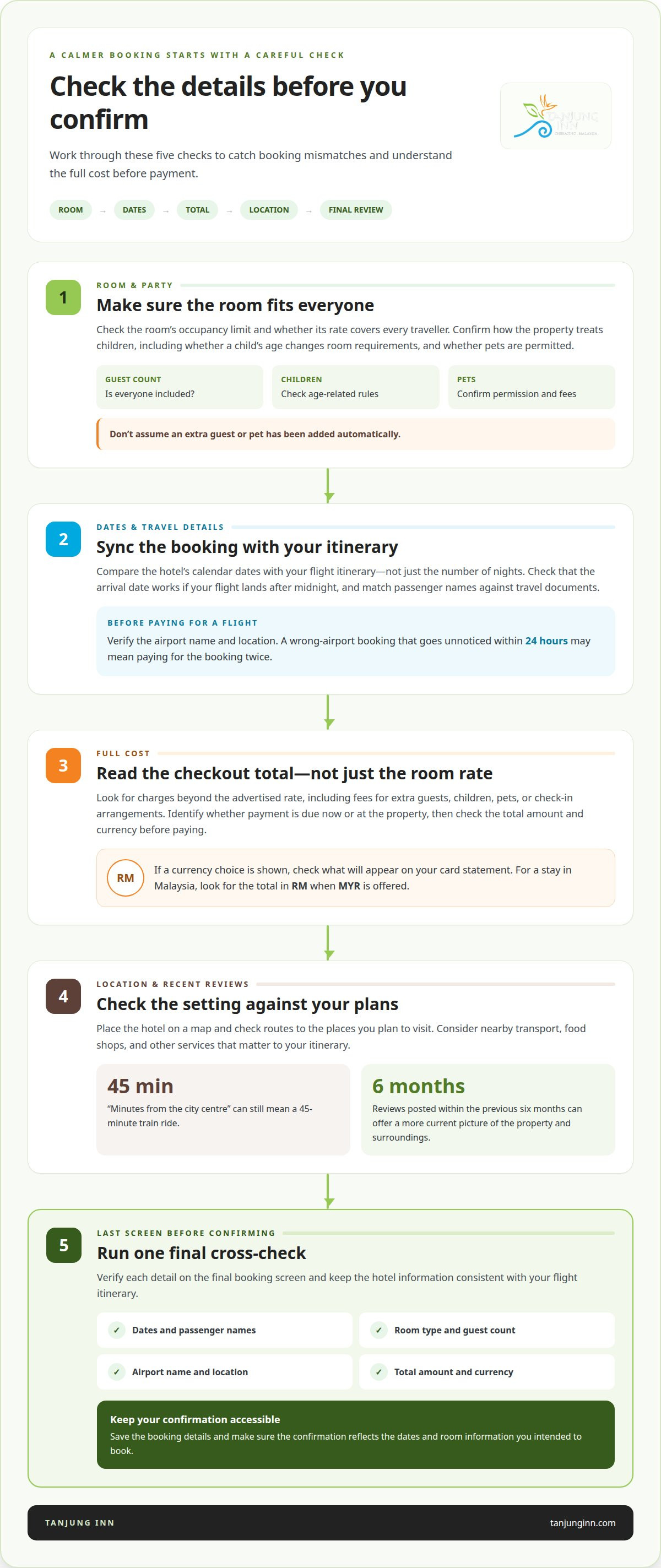
Before booking a hotel room, check the dates, occupancy limit, extra charges, location, and total shown at checkout. Match the room details to your flight itinerary, then review the payment currency and booking summary before confirming. These small steps can catch errors before they shape the whole trip.
Start with the guest count. A room’s stated capacity may not explain how children, extra guests, or pets are treated, so read the occupancy and fee details for your chosen room. Check whether the listed rate covers everyone travelling, whether a child’s age affects the room requirements, and whether pets are permitted. If your group includes a pet or an additional guest, don’t assume the booking form has included them automatically.
Next, compare the hotel’s arrival and departure dates with your flight itinerary. Check the calendar dates, not just the number of nights, and make sure the arrival date still works if your flight lands after midnight. Review passenger names against travel documents before confirming a flight booking. A wrong-airport booking that goes unnoticed within 24 hours may mean paying for the booking twice, so confirm the airport name and location before payment.
Read the full cost summary for charges beyond the room rate, including any fees shown for extra guests, children, pets, or check-in arrangements. Note whether payment is due now or at the property, and identify the total amount and currency before paying. If the screen offers a choice of currencies, check which one will appear on your card statement. For a stay in Malaysia, look for the displayed total in RM when MYR is offered.
Then place the hotel on a map. A description such as “minutes from the city centre” can still mean a 45-minute train ride, so check the route to the places you plan to visit. Look for nearby transport, food shops, and other services that matter to your itinerary. Google Maps can help you understand the surroundings before booking, including the walking routes and distance between the hotel and your planned stops.
Check recent guest reviews for practical details about the property and its setting. Reviews posted within the previous six months can give you a more current picture of the surroundings and stay experience. Compare comments with the room description, especially if quiet, convenient transport, or nearby services matter to your plans.
One of the common booking mistakes to avoid is treating the advertised room rate as the final cost. Before confirming, pause at the last screen: verify the dates, passenger names, room type, guest count, airport, total, and payment currency. Keep the details consistent across your flight itinerary and hotel confirmation. A careful final review helps prevent avoidable surprises on arrival.
2. Understanding cancellation and prepayment terms
Before paying, identify the cancellation deadline, refund conditions, prepayment amount, and rules for changing dates or guest details. Hotel policies differ: some allow free cancellation until 24 hours, 72 hours, or a week before arrival, while others charge the first night after cancellation. Read the terms attached to the exact rate you selected.
A low rate may be non-refundable, which means cancelling could leave you responsible for the booking cost. A refundable option can offer more flexibility if plans change, though it may cost more. Compare the difference with the likelihood of changing your plans, rather than choosing solely by the lowest displayed rate.
Look for the deadline’s time zone and the event that starts the cancellation window. A policy might count back from arrival, while a booking confirmation may state a specific date and time. Flexible hotel rates commonly set the free-refund period three to 30 days before arrival. Record the deadline in your calendar and keep the policy with your confirmation.
Check how prepayment works. The booking page should make clear whether the full amount is charged immediately, only part is collected, or payment is due later. Note whether cancellation returns the amount paid, whether any charge applies, and how a refund is issued. A “free cancellation” label matters only if its conditions cover your rate and timing.
Changes and cancellations are not always treated alike. Check whether changing dates, shortening a stay, or changing guest details counts as a cancellation or requires a new booking. If plans change, promptly use the booking channel’s stated process, keep a record of your request, and save any written response. A phone conversation alone may not leave a clear record of the agreed change.
For businesses, clear cancellation terms belong on booking pages and in confirmation emails. State the applicable deadline, any prepayment conditions, and how to request a cancellation or reschedule. If a change affects a booking, communicate the updated dates and outcome in writing so both sides have the same details.
Before confirming, read the policy from top to bottom, including exceptions and the final payment screen. Save a copy or screenshot of the terms shown at purchase; later, compare it with the confirmation email. This simple record helps you understand which rules apply if your plans change. As you consider a stay, you can also explore accommodation options while reviewing the terms for your selected rate.
The lowest-priced rate may be non-refundable, so check the hotel’s cancellation policy before booking. A refundable hotel booking can offer greater flexibility if travel plans change, although it may cost slightly more. Keep the policy in view when choosing a rate, rather than assuming the displayed price alone tells you what can be recovered.
Booking systems can let clients cancel or reschedule within the stated policy guidelines. Businesses can remind clients about cancellation policies closer to appointment dates and should inform clients about booking or service changes, including rescheduling or cancellations. Clear communication helps clients understand the applicable process when plans shift. For a hotel stay, verify that any requested change follows the policy attached to the booking, and keep a record of the outcome.
3. Choosing value over the lowest room price
A low room rate shows only one part of what a stay offers. Compare the final booking total, room suitability, location, and what matters during your trip. For example, a cheaper room far from your planned activities may require more time and transport. A room that fits your group and itinerary can offer better value, even if its displayed rate is higher.
Begin with your reason for travelling. If your plans centre on a beach, a room near the coast may be more useful than one closer to town. For a short stop, convenient access to your main destination may matter more than extra space. Write down your priorities, then compare each room against the same needs instead of relying on a “best deal” label.
Next, compare like with like. Check the room type, guest capacity, bed arrangement, included features, and booking terms for each option. A lower rate may apply to a different room or a less flexible booking. Use the final cost summary, not the first price shown, and make sure each comparison covers the same dates and number of guests.
Travel dates can change room value. Flights, car rentals, and hotels can cost 25% to 75% more during holidays and peak travel seasons, with prices potentially rising further as availability decreases. For popular travel periods, booking at least six months in advance can give you more room types and inventory to choose from. Compare options early, then decide based on fit and total cost.
Read reviews for details that match your priorities. If a quiet night matters, look for comments about noise; if you’ll arrive by public transport, check descriptions of the route and nearby stops. Reviews posted within the previous six months can provide more current details. Treat each comment as one traveller’s experience, and look for recurring information relevant to your plans.
Consider the time and effort a location adds. Use a map to trace the route from the hotel to your planned stops, such as a beach, meeting venue, or transport station. Check whether nearby food shops or other services fit your schedule. A short walk may be more valuable than a room feature you won’t use.
Finally, rank your options using a simple comparison: total cost, room fit, location, useful features, and flexibility. Give the most weight to factors that shape your actual stay. This helps prevent the common booking mistake of choosing a low rate before checking whether the room suits your planned trip.
4. Risks of booking through third-party travel agencies
A third-party travel agency adds another party between you and the hotel. If a name, date, or room detail is wrong, you may need to contact the agency first and wait for it to coordinate with the property. Before paying, note who issued the confirmation and who handles changes. That distinction matters if your plans shift during a holiday.
Third-party bookings can be useful for comparing options, but the listing and final confirmation must match. Check the property name, room description, dates, guest count, cancellation terms, and payment status on both screens. For example, if a listing shows a family room but the confirmation names a different room type, resolve the mismatch through the booking channel before travelling.
To reduce the risk of scams or misleading listings, use a booking channel you can identify, compare the listing with the property’s own details, and keep payment and booking messages within the stated process. Be cautious if someone asks you to pay through an unrelated link or transfer money outside the booking channel. Urgency is no substitute for a clear confirmation.
Review listing photos and descriptions as carefully as the headline. Check that the photographs show the room type you selected, and read the details about bed arrangement, guest capacity, and what the rate covers. Search the property name and location on a map to make sure the listing points to the place you intend to stay. Check that the name and address are consistent across the listing, confirmation, and payment record.
Keep a record of each step. Save the booking confirmation, payment receipt, cancellation terms, and messages about any changes. If the agency provides a booking reference, store it with the hotel’s name and arrival date. When contacting support, provide the reference and describe one issue clearly, such as a date mismatch or missing confirmation. Keep the reply with your other records.
Booking directly with a hotel can help travellers access loyalty points and avoid resolving booking issues through a third-party agency. It may be simpler when you already know the property and want to keep the booking conversation with the hotel. A third-party agency may still suit a comparison across several stays; choose the route that best fits how you plan to manage your trip.
Before confirming, pause and ask who will handle a cancellation, amendment, or billing question. Save the support details shown with your booking, and use the same channel for follow-up. These steps help limit surprises and make it easier to trace your reservation if an unexpected change affects your holiday.
5. Sending booking confirmations and reminders
A confirmation is the written record of what you reserved. After paying, save the email or text and check its booking reference, property name, dates, room type, guest count, and payment status. For example, if you reserved a room for Friday night, make sure the confirmation shows Friday as the arrival date, not Saturday. A clear record helps you spot mismatches while there’s still time to address them.
Keep the original message somewhere easy to find, such as a travel folder in your email. If the booking process offers a downloadable confirmation, save a copy on your phone so you can access it without searching through old messages. Keep the payment receipt and any later change notices with it. These records make it easier to explain an issue using the booking reference and exact details.
Automated confirmation and reminder emails or texts can keep guests informed about booking status. A useful reminder repeats the arrival date, property name, and booking reference, rather than relying on a vague message such as “Your stay is coming soon.” If a reminder shows different dates from the original confirmation, compare both records and use the booking channel’s stated support process to resolve the difference.
Time zones can affect bookings that involve travel across regions. Check whether the booking page and confirmation show the relevant time zone, especially if an arrival time or deadline matters. For an appointment or stay scheduled across regions, stating the time zone beside the time helps prevent confusion. A clear example is “arrival at 3 pm Malaysia time,” instead of “arrival at 3 pm” alone.
After making a reservation, check your inbox and text messages, including spam or promotions folders. If no confirmation arrives, search for the property name, booking reference, or payment receipt before starting a second booking. Paying again too quickly can create duplicate reservations. Keep a screenshot of any completed confirmation screen while you look for the message.
Before travelling, compare the latest reminder with your itinerary. Confirm the arrival date, guest names, room details, and any written changes. If your arrival time has shifted, follow the contact instructions in your confirmation and share the updated detail. A short, clear message gives the recipient your booking reference and explains what needs attention.
For a Cherating stay, choose accommodation for your group and keep its confirmation with your travel details. A few saved records can bring more ease to the journey.
Businesses can confirm appointment times with clients in their local time zones, giving both sides a clear reference when reviewing the appointment. They can follow up before appointments to clarify uncertainties or gather additional information. A concise follow-up can focus on the point that remains uncertain or the information needed. Once clarified, review the appointment details together and address any remaining questions. These steps keep confirmation and follow-up focused on the details that need attention, rather than leaving uncertainty until the appointment itself.
Tanjung Inn
Tanjung Inn offers accommodation options for travellers comparing room value and group size for their travels. Its Grand Villa for 6 Pax, Family Villa 5 for 5 Pax, Family Villa 4 for 4 Pax, and Family Villa 3 for 5 Pax give different groups options to consider. Match the capacity to your party, then review the room details and booking terms before confirming, so the choice suits both your stay and your plans.
If you’re planning a trip and want to explore these options, contact Tanjung Inn to avoid common booking mistakes to avoid during your reservation process.
Make room for a more considered stay
A well-chosen stay begins before arrival, with a booking that fits the way you want to travel. Let the practical details support the experience, then make space to look forward to the place, quieter moments, and time away from routine. The common booking mistakes to avoid are easier to prevent when each decision reflects your plans rather than a rush to finish.
If Cherating is part of your next journey, Tanjung Inn offers accommodation options for different group sizes, including chalets for two and three guests. Consider what suits your travel party, then explore the available options and book when you’re ready. A thoughtful choice can make your stay feel more settled from the beginning.
Contact Tanjung Inn about your booking and take the next step toward your time away. May the planning feel clear, and the journey bring a welcome change of pace.


