

A traditional Malay style chalet stay is best understood through its layout. A traditional Malay house commonly has two parts, the main Rumah Ibu and the kitchen annexe called the Rumah Dapur, as well as at least one raised veranda, or serambi. These features show how shared family spaces can sit alongside quieter corners. The appeal lies in that balance.
Timber details and a veranda’s view may catch your eye, but a comfortable stay also depends on practical features and a layout that suits your group. This guide explores kampung-style layouts, family-friendly arrangements, verandas and amenities to help you decide what matters for your trip in Malaysia. Consider where you’ll gather, rest and enjoy the outdoors, and how those spaces fit your plans.
Key Takeaways
- Compare chalet layouts by how they separate shared gathering areas from quieter sleeping spaces.
- Use your group’s routines to decide which practical amenities matter most, from preparing for the day to settling in at night.
- Choose room arrangements that give family members enough space to rest and spend time together comfortably.
- Look at how a veranda can extend the living area, offering a shaded place to pause and enjoy the surroundings.
- When comparing Malaysian stays, consider both the local setting and how well the accommodation suits your group.
Guesthouse layout and kampung living
A traditional Malay home offers a useful model for understanding kampung-style stays. Its two parts are the Rumah Ibu, or main house, and the Rumah Dapur, or kitchen annexe. This arrangement separates gathering and resting spaces from cooking activity. When comparing accommodation, look for the same practical logic: where everyone can sit together, where meals happen and where sleeping areas offer privacy. A traditional Malay style chalet stay can echo this layout without reproducing every feature of a heritage home.
Raised construction is another familiar feature. Traditional Malay houses are commonly built on stilts, which can help with ventilation and protection from floods and wild animals. Timber and bamboo are often joined through fitted holes and grooves rather than nails. Roofs provide shade and shelter from tropical heat and rain while allowing air to move. These details show how design responds to its setting, and offer guests a way to notice how shade, airflow and shared spaces shape daily routines.
Kampung-style stays vary across Malaysia because building traditions and landscapes differ. A house in an east-coast village may look unlike one in Perak or Selangor, yet both can connect indoor life with the surrounding community. Use the layout as a guide: identify the common area, quieter rooms and routes between them. Then consider whether the arrangement suits your group’s habits, such as sharing meals or heading out early.
Kampung Stay Pos Hau in Gua Musang
Situation: A family considering Kampung Stay Pos Hau in Gua Musang wants a village setting and space to gather. Action: They map the sleeping spaces, shared areas and access between the main house and kitchen before choosing an arrangement. Result: They can judge whether the layout supports time together and individual rest. This is a planning example, not a claim about the property’s specific floor plan.
Check-in times, cancellation terms and house rules depend on the property and reservation. Read the booking terms for arrival and changes, then follow the guidance on shared spaces, noise and care of the home. When visiting a village, greet hosts respectfully, dress considerately in communal settings, ask before photographing residents and keep voices low near neighbouring homes. These small choices show respect for local culture and the people who live there.
There is no single average nightly price for a Malay-style chalet across Malaysia. Rates depend on location, season, room capacity, and amenities, and the price for a particular stay is given after a quote request. Compare options by matching those factors, rather than judging unlike rooms as though they were equivalent.
Chalet amenities and facilities
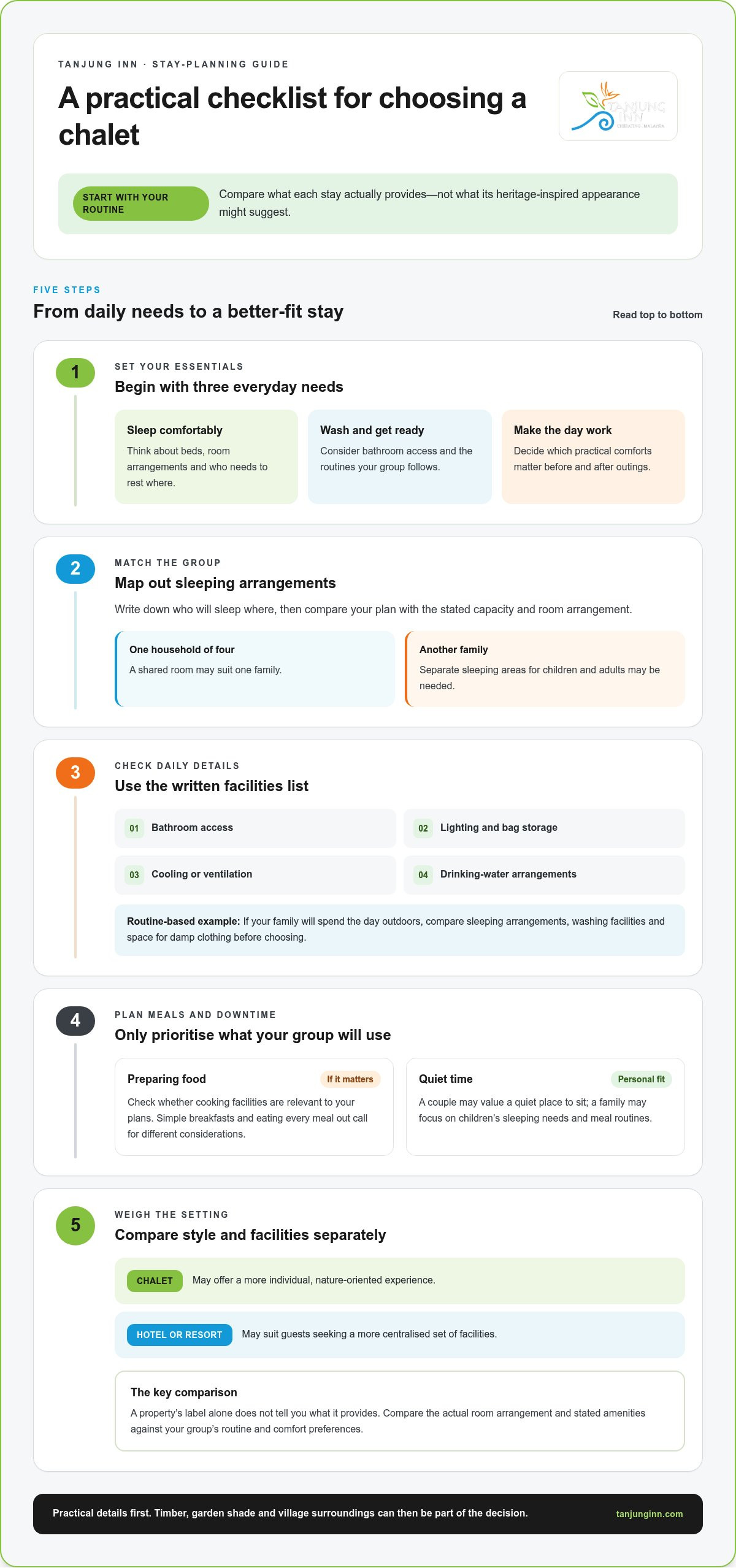
For a heritage-inspired stay, judge amenities by how they support your routine, not by the length of the list. Start with three needs: sleeping comfortably, washing and getting ready for the day. Then compare each chalet’s stated facilities against them. A family travelling with young children may prioritise convenient bathroom access, while a couple may value a quiet place to sit. These are practical considerations, not guarantees about every traditional chalet.
Make a short checklist before booking. Check the sleeping arrangement, bathroom access, cooling or ventilation, drinking-water arrangements and places to keep belongings. Consider cooking facilities only if preparing food matters to your group. Someone planning simple breakfasts will have different needs from someone intending to eat every meal out. Compare each property’s stated details rather than assuming a heritage appearance means modern amenities are present or absent.
- Rest: Match the stated beds and room arrangement to your group’s needs.
- Daily routines: Consider bathroom access, lighting, and a place to store bags.
- Meals: Decide whether you need food preparation space or nearby dining options.
- Setting: Weigh natural airflow and outdoor surroundings against your comfort preferences.
Use this example to assess a stay. Situation: A family expects to spend the day outdoors and return in the evening. Action: They compare sleeping arrangements, washing facilities and space for damp clothing before reserving. Result: They can choose based on their daily routine instead of relying on decorative photographs alone. The same approach works for a couple comparing a simple chalet with a hotel room.
Traditional Malay chalets and hotels or resorts differ mainly in setting, layout and style of stay. A chalet may offer a more individual, nature-oriented experience, while hotels and resorts may suit guests seeking a more centralised set of facilities. Compare the actual amenities and room arrangements, since a property’s label alone doesn’t tell you what it provides.
To book, choose your dates and group size, compare the listed room and facility details, then follow the property’s reservation process. Reserve earlier for school holidays or public holidays, when more travellers may be planning time away. Read the cancellation terms and check-in instructions before paying, and save your booking details for arrival.
Example: A couple choosing between a quiet chalet and a resort lists essential comforts, then compares the written details for each. A family can follow the same steps, adding children’s sleeping needs and meal routines. This keeps the decision practical while leaving room for the pleasures of timber, garden shade and village surroundings.
Family-friendly chalet accommodation
For a family trip in Malaysia, start with the group’s sleeping needs, not the chalet’s photographs. One household of four may prefer a shared room, while another may need separate sleeping areas for children and adults. Write down who will sleep where, then compare your plan with the stated capacity and room arrangement. A good fit makes evening routines easier, especially after a warm day outdoors.
Next, map out your family’s day. A tropical outing can mean wet clothes, sandy footwear and tired children returning together. Consider where bags can go, how guests move between sleeping and washing areas, and whether everyone can get ready without crowding. These details matter more than decorative touches if family members return at different times. Choose a layout that supports your usual rhythm.
- Sleeping: Match the stated guest capacity to the people travelling, including children.
- Daily routines: Think through changing, washing, and storing bags after outdoor activities.
- Shared time: Identify a place where the family can sit together between outings.
- Rest: Consider whether different bedtimes call for more separation between sleepers.
Use a simple example. Situation: A family of five plans a few days near Malaysia’s coast, with adults and children following different bedtime routines. Action: They compare the listed capacity, sleeping arrangement and shared space, then consider how everyone will settle in after a day outside. Result: They can choose a layout that suits the group rather than squeezing into a room based only on location or appearance.
For a family of four, the decision may depend on whether children can comfortably share sleeping space or need more separation. For a family of five, make sure the stated capacity matches the whole group rather than assuming a sofa or extra bed is available. Capacity is a starting point, not the whole picture. The arrangement should also work for luggage, changing and quiet moments.
Before booking, compare the stated capacity with your group, read the room description and match the arrangement to your daily routine. Then plan what the family needs to bring, such as familiar sleep items for young children or a separate bag for beachwear. Keep meals and rest in mind, too. A chalet that supports shared time and individual downtime can make a family break feel calmer.
Finally, discuss expectations with the children before arrival. Explain where shoes go, how to keep shared spaces tidy and why quieter voices matter around neighbouring homes. For example, after a beach walk, your family can leave sandy footwear in the agreed area before settling indoors. Small routines help everyone care for the space and enjoy the slower pace of a kampung-style escape.
Interior rooms and verandas
A traditional Malay house has at least one raised veranda, called a serambi, for seated work, relaxation or receiving less familiar visitors. The veranda is more than an entrance: it can mark the threshold between village life and private rooms. In a chalet, notice how the outdoor sitting area connects with the interior and whether guests can move between them without disturbing people resting inside.
When inspecting a room, start with the route from the entrance to the sleeping area. Look for a place for shoes, bags and everyday belongings that won’t block the way. Then consider how the room serves different moments: sleeping after a day outdoors, changing before dinner or giving a child somewhere quiet to rest. These questions are useful for any stay, whether the interior follows traditional forms or a simpler contemporary layout.
A serambi can support several quiet routines. One guest might read while another talks with a host; a family can sit together before heading out. As the traditional veranda also serves as a place to receive visitors, it offers a natural spot for conversation without immediately entering private rooms. Notice its shade, seating and connection to the entrance, then consider whether the space suits your group’s habits.
- Room use: Identify where guests sleep, change, and keep their belongings.
- Movement: Trace the path from entrance to room, bathroom, and veranda.
- Shared space: Consider whether the serambi supports conversation or quiet rest.
- Privacy: Notice whether veranda activity sits apart from sleeping areas.
Traditional Malay houses vary by state and community, so no single interior arrangement represents every heritage home. Treat each chalet as its own example. Look at how openings, shaded areas and room placement relate to the local climate and setting, rather than expecting a standard floor plan. In Malaysia’s warm, humid conditions, the relationship between indoor rooms and sheltered outdoor space can shape how guests use a home throughout the day.
Situation: Two relatives want to chat while another guest rests. Action: They use the serambi for conversation and keep the sleeping room quiet, making deliberate use of the space between them. Result: Each person has a place suited to their activity without needing a complicated schedule. This simple example shows why room function matters as much as appearance.
Before settling in, take three practical steps: locate the sleeping space, find the veranda entrance and agree on where shared belongings go. For a family, decide which room is the quiet retreat and which area suits conversation. A solo traveller can use the veranda as a place to pause with a book or listen to the surroundings. These small choices let the interior and serambi work together, making room for both company and calm.
Where can I find traditional Malay-style chalets in Malaysia?
Start with the region, then distinguish heritage architecture from chalet accommodation inspired by village life. Perak is known for Rumah Kutai houses, while east-coast Peninsular Malaysia has houses with carved roof gable-end boards. In Melaka, some traditional Malay homes feature colourfully tiled staircases. These are architectural references, not a guarantee that every destination offers overnight stays in heritage houses.
For a village setting, search by both place and experience. Kampung Stay Pos Hau is in Gua Musang and offers a named starting point for exploring kampung-style accommodation in Malaysia. Compare its setting and stated room arrangement with your trip’s needs. A village stay may offer a different pace from a town-based chalet, so consider whether you prefer nearby shops and transport or a quieter rural landscape.
East-coast destinations can suit travellers drawn to coastal scenery and local timber-house details. Cherating, Pahang, is one option for a nature-oriented chalet break, while the wider east coast offers distinctive gable-end designs in traditional houses. Treat the architecture as a point of cultural interest, not proof that a particular chalet uses historic construction methods. Read each property’s description carefully.
Access matters as much as atmosphere. A Petaling Jaya chalet listing describes a nearby train station with a 15-minute journey to central Kuala Lumpur. A Sepang listing describes a fastest-train journey to Kuala Lumpur within 25 minutes. These examples show how transport can shape a stay, but they don’t establish that either listing has traditional Malay architecture. Check the destination’s actual setting against your plans.
- For heritage details: Explore Rumah Kutai in Perak or traditional east-coast gable boards.
- For village living: Use Gua Musang and Kampung Stay Pos Hau as a starting point.
- For transport access: Compare station connections and journey details with your itinerary.
- For coastal nature: Consider Cherating and other east-coast settings, then assess each property’s features.
Situation: A family wants village character but also needs straightforward travel. Action: They shortlist Gua Musang and an east-coast destination, then compare transport, room layout and the surrounding setting. Result: They can choose between a rural village experience and a coastal break based on practical fit, not appearance alone.
Use this three-step search: choose a Malaysian region, search for chalets or homestays in named towns, then compare descriptions for layout, setting and access. For a traditional Malay style chalet stay, this approach helps distinguish genuine cultural context from styling alone. Architecture, landscape and everyday surroundings all shape the experience.
Tanjung Inn: Grand Villa for 6 Pax
Tanjung Inn offers the Grand Villa for 6 Pax, a practical option for a larger group seeking nature-oriented accommodation in Cherating, Pahang. It gives families or friends a named choice with capacity for six guests, while the Family Villa 5 for 5 Pax, Family Villa 4 for 4 Pax, and Family Villa 3 for 5 Pax offer other group-size options. Choose by matching the stated capacity to your travelling party and considering how you want to share your time together.
If a group stay in Cherating suits your plans, explore Tanjung Inn’s villa options after comparing layouts and settings. Start with your group size and preferred pace, then choose the accommodation that fits. Visit Tanjung Inn’s website to explore the options and book your stay.
Choose the Stay That Fits Your Gathering
Start with the feeling you want to carry home: slow mornings, time outdoors or an easy place for everyone to gather. For a traditional Malay style chalet stay, use that picture to guide your choice, then match the accommodation to your group and the kind of rest you’re seeking. A thoughtful fit can make the stay feel less like a schedule and more like a shared pause.
Tanjung Inn offers the Grand Villa for 6 Pax, Family Villa 5 for 5 Pax, and Family Villa 4 for 4 Pax. These options give different-sized groups a clear starting point for considering a stay in Cherating. Let your group size lead, then choose the setting that suits your plans.
Contact Tanjung Inn about your stay and take the next step toward a restful time together. A quieter pace is within reach.
Frequently Asked Questions
What is a traditional Malay-style chalet stay in Malaysia?
A traditional Malay style chalet stay is accommodation shaped by Malay house design or kampung surroundings, offering a quieter alternative to standard hotel rooms. The phrase can describe heritage-inspired architecture, a village setting, or both, rather than one fixed building style. For example, look for timber details, shaded outdoor areas, and a layout that connects indoor living with the surrounding landscape. Properties differ, so consider the setting and room arrangement together.
What amenities and facilities do traditional Malay chalets typically offer?
Amenities vary by property, so the description matters more than the traditional label. Tanjung Inn lists air conditioning, a shower, a water heater, a working table, parking, garden views, a garden and a gazebo. Consider your routine: a working table may help with quiet tasks, while a gazebo offers an outdoor place to sit. These details can help you decide whether a traditional Malay style chalet stay suits your plans.
Are traditional Malay chalets suitable for families and groups?
Yes, they can suit families and groups when the stated capacity and sleeping arrangement match the people travelling. Before choosing, consider children’s bedtime routines, how much shared space your group needs and whether everyone can move around comfortably with luggage. Relatives travelling together might prefer a shared living area, while a family with different sleep schedules may value more separation between sleeping spaces. Choose based on fit, not appearance alone.
What are the best traditional Malay chalets near Kuala Lumpur?
The Petaling Jaya listing is near a train station with a 15-minute journey to central Kuala Lumpur, and grocery shops, a laundry, and eateries are within 200 metres. The Sepang listing says guests can reach Kuala Lumpur by the fastest train within 25 minutes.


